A Cut Above – Inside Damen’s Cutter Suction Dredger Training Simulator
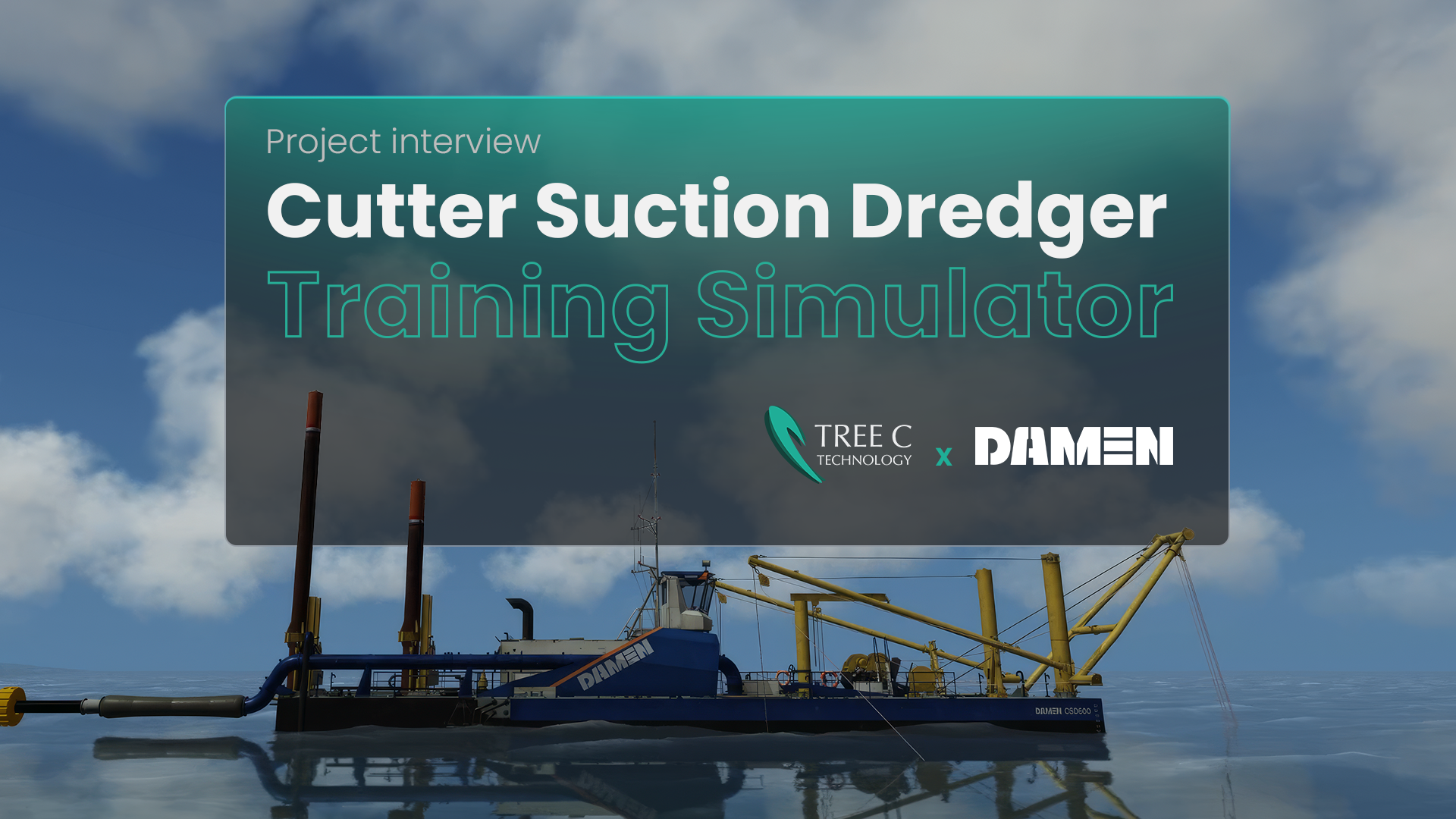
Damen – one of the world’s leading dredger manufacturers and maritime solutions providers – is expanding its operator training program using Tree C simulator technology.
If you’re familiar with underwater operations like dredging, then you know that skilled operators are vital for consistent production, efficiency, and safety. You’ll also be aware of the cost and complexity involved with training operators using real-world equipment.
That’s why, in partnership with Tree C, Damen has developed its own Cutter Suction Dredger (CSD) Training Simulator, a next-generation system that captures the full physics, feel, and complexity of dredging operations while delivering unprecedented flexibility, portability, and return on investment.
Understanding the underwater landscape
Damen’s Parts and Service team, led by Wouter Beekman, manages after-sales activities for dredging equipment worldwide. His team supports spare parts sales, service coordination, and field service engineers, but their mission goes far beyond maintenance.
That commitment to long-term partnership – as opposed to one-time transactions – has created the need for a new kind of CSD simulator. Developed in partnership with Tree C, the new simulator can be used for both product demos and for training operators.
“We don’t just push equipment sales, we actually help clients to optimize their dredging operations. That’s why it’s important to offer exceptional support for our clients beyond product delivery.”
– Wouter Beekman, Manager Parts & Service, Damen Dredging Equipment
The new CSD training simulator helps address two key operational challenges dredging companies are facing. Firstly, operators of a cutter suction dredger (CSD) must pay close attention to multiple variables, including soil conditions, pump pressure, and cutter resistance, to avoid delays and damage to equipment. But they must also work without clear visibility of the underwater landscape. For those reasons, the reality of training on live equipment is often impractical due to downtime, fuel costs, and the constant risk of wear or damage.
Secondly, dredging companies are always looking for ways to streamline and improve their operations. Delays and setbacks can be costly. So when they invest in new dredging equipment and vessels, they expect maximised uptime, higher production rates, and measurable efficiency gains.
Setting goals for simulator development
Unlike navigational simulators, a CSD simulator has to replicate a stationary production process rather than vessel maneuvring. Operators don’t steer, instead, they manage soil cutting and hydraulic transport.
The key is to maximize efficiency (cubic meters of sand per hour) and effectiveness (minutes per day producing), while minimizing fuel use and downtime. As Wouter puts it: “You can deliver a technically perfect dredger, but what if the operator isn’t successful in their project? The simulator helps ensure their success.”
For Damen itself, the new CSD simulator serves two complementary purposes:
- Marketing and sales: Visitors at Damen’s yard get a hands-on, realistic experience of operating a cutter suction dredger.
- Operator training: The ability to teach real-world production principles to clients worldwide with a portable simulator that can fit in a flight case.
“We visited several potential simulator developers. Tree C stood out because so many of our requirements were already available in their off-the-shelf simulator framework. The Tree C team was also open, flexible, and genuinely collaborative.”
– Wouter Beekman, Manager Parts & Service, Damen Dredging Equipment
Damen had previously built a CSD simulator, an in-house system developed nearly a decade ago. It worked, but it was limited, and the company’s new generation of dredgers demanded more sophisticated training. With an entirely new CSD series featuring updated PLC control systems and digital interfaces, the need for a matching simulator became clear.
Wouter Beekman led the initiative by developing the business case, securing approval, and searching for a technology partner capable of translating Damen’s dredging expertise into an immersive training platform.
That search led to Tree C.


Seeing beneath the surface
One of the most distinctive features of the Tree C simulator is its underwater visualization. For the first time, operators can actually see the cutting process, and the soil breaking and flowing: something that’s invisible in real life.
Dredging is typically a blind process; sonar is unreliable in the dense sediment clouds created during operation. With Tree C’s high-fidelity 3D visualization, instructors can demonstrate cutting angles, swing speeds, and soil responses visually rather than relying on whiteboard sketches.
That realism helps operators understand cause and effect: how soil hardness, cutter load, and pump pressure interact to affect performance. It turns an abstract concept into an intuitive learning experience.
Composing and customizing new training scenarios
“With Tree C’s composer mode, I can create and modify scenarios myself – different soil types, dredging depths, or cutting conditions – on the spot.”
– Wouter Beekman, Manager Parts & Service, Damen Dredging Equipment
For Damen, flexibility was non-negotiable. Wouter’s team wanted full control over training content without needing external developers to program every new scenario. The autonomy facilitated by Tree C’s simulator framework is a major advantage.
Damen’s trainers can now tailor exercises to client projects, realistically replicating the conditions of actual dredging sites. Whether soft soil in a shallow port or compact clay in a deep river, operators can practice under conditions that mirror their own challenges.
Integrating Damen’s deep expertise and DLL files
Damen’s in-house knowledge of dredge pumps and cutting mechanics is world-class. Over the years, its engineers have developed proprietary software modules for hydraulic transport and cutter head performance: key components of efficient dredging.
Unlike other simulator developers, Tree C is able to integrate these modules, known as DLL files, directly into the simulator framework. This ensures the system combines Tree C’s advanced physics engine with Damen’s authentic process expertise. Together, three interconnected modules simulate a complete dredging operation:
Tree C’s software then feeds all the data into the identical PLC used on Damen’s dredgers, allowing operators to view authentic pressure and vacuum readings on their familiar control interfaces. This combination of simulation precision and proprietary knowledge and hardware-in-the-loop produces a high level of realism.
Combining portability, efficiency, and ROI
“If we want a real business case, the simulator has to be portable. Now, we can send one instructor with a suitcase anywhere in the world.”
– Wouter Beekman, Manager Parts & Service, Damen Dredging Equipment
In previous generations, simulators were large, fixed installations, difficult to transport and costly to deploy overseas. For Damen’s global training ambitions, that simply wasn’t a sustainable option.
One of Wouter’s most ambitious goals was to make the simulator fit into a single suitcase of no more than 32 kilograms. Put another way, it was to be no heavier than a standard piece of luggage for a passenger plane.
Against all expectations, the team achieved it.
This portability has transformed Damen’s training model. Instead of flying multiple operators to the Netherlands for a week of training, one Damen instructor can deliver on-site sessions anywhere in the world, reducing travel costs, time, and logistical hurdles for clients.
It’s a win-win: better access to training and faster return on investment for both sides.

Simulator training at home and abroad
The simulator sees active use at Damen’s dredging yard, where visiting clients experience the CSD office simulator as part of the factory tour. It’s also traveling the world, recently used in Asia for client training sessions that generated a wave of positive feedback and new ideas for future improvements.
For Damen, this project is about much more than adopting the latest and greatest simulator technology. It’s about strengthening client partnerships and ensuring long-term success with every vessel and each piece of equipment delivered. For the team at Tree C, it’s a milestone collaboration, one that demonstrates what’s possible when domain expertise meets simulation excellence.
“The collaboration with Tree C has been very professional and respectful,” Wouter concludes. “We’re 95% complete with the current scope, but this is just the beginning.”
The next phase will focus on embedding the simulator into broader training programs, creating tailored modules that mirror real dredging projects around the world. With its flexible framework, proprietary integration, and portable design, this system represents the future of dredging operator training.
Partnering for the next generation of offshore training
As digital transformation reshapes the maritime industry, simulators like Damen’s CSD system are setting a new benchmark for how you train, sell, and support complex equipment. If your company is developing or modernizing offshore or underwater missions, and you want your operators performing at their peak, Tree C can help you achieve it.
To get updates on this exciting project, subscribe to our newsletter and follow Tree C on LinkedIn.